


13/10/2026
Vietnam’s Resolution 04/2026: A Legal Breakthrough for Thu Thiem and District 1 Luxury Real Estate?
Resolution 04/2026/NQ-HĐTP, effective Oct 15, eases penalties for land-law cases tied to special projects. What it means for Thu Thiem, D1 luxury real estate.
Starting October 15, 2026, Resolution 04/2026/NQ-HĐTP issued by the Judicial Council of Vietnam’s Supreme People’s Court takes effect, allowing courts to consider reduced penalties for land-law violations tied to projects under special mechanisms and policies, depending on how much economic damage has been remedied. The move does not stand alone. It follows a string of legal fixes rolled out across eastern Ho Chi Minh City through 2026: the Government’s agreement on a BT (build-transfer) payment formula for Thu Thiem under Decree 91/2025/NĐ-CP, a draft amended Real Estate Trading Law, and an amended Land Law now before the National Assembly at its October 2026 session. For anyone eyeing luxury property in District 1, Thu Thiem, or Rach Chiec, the real question is how these legal shifts affect supply, pricing, and the legal safety of projects already underway.
What Resolution 04/2026/NQ-HĐTP actually does
The resolution covers cases that arose before August 1, 2024, involving land-law violations at projects operating under special mechanisms approved by competent authorities. In some situations, courts may even consider exempting a defendant from criminal liability during trial, provided the person was not involved in corruption, the project was completed and delivers real socio-economic benefits, and related complaints have already been resolved.
For cases where damage has not been fully remedied, the trial panel weighs three factors: the share of economic damage remedied by the time of trial, the project’s actual socio-economic effectiveness, and how well it meets the conditions of its special mechanism. Penalty reductions follow a tiered scale based on how much damage has been fixed:
- Up to 25% remedied: a reduction of as much as one-quarter of the penalty.
- 25-50% remedied: up to one-half off.
- 50-75% remedied: up to two-thirds off.
- 75% to just under 100% remedied: up to four-fifths off.
Courts may also postpone a trial for up to 30 days to let a defendant remedy damage. However, if a project is already finished but the damage has not been fixed, the case must still proceed to trial, verdict, and enforcement as normal — no postponement or suspension applies.
Why this matters directly for luxury real estate in Thu Thiem and District 1
Many projects in the new Thu Thiem urban area carry a legal history tied to land-swap arrangements, BT infrastructure payments, or land-use auctions stretching back more than a decade. The Government had already agreed to apply Decree 91/2025/NĐ-CP to clear BT payment bottlenecks in the area. Resolution 04/2026/NQ-HĐTP goes a step further, lowering the residual legal and criminal risk tied to a handful of special-mechanism projects, on condition that developers actively remedy the economic damage — in theory shortening the time needed to resolve legacy issues and speeding up pink-book (land-title) issuance and handover.
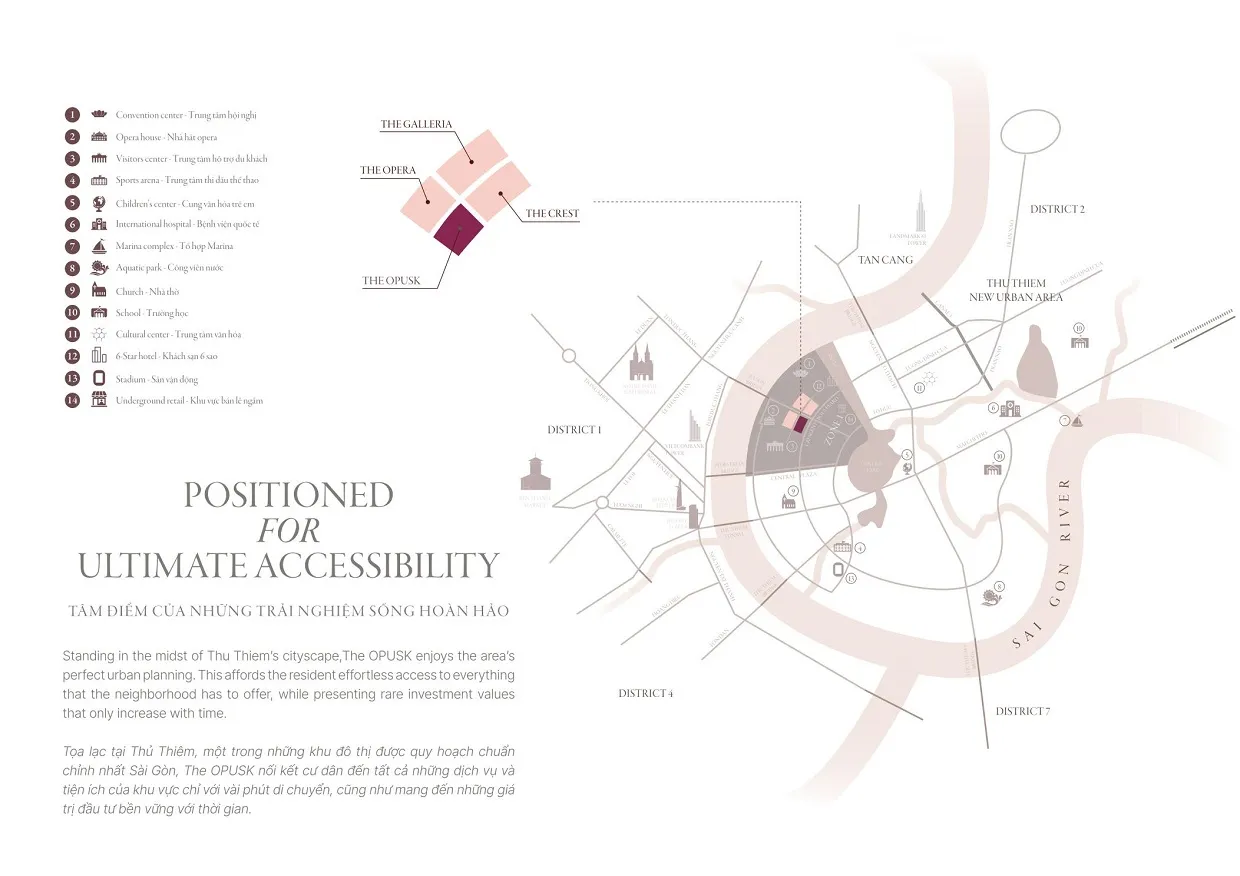
At the same time, Ho Chi Minh City is completing the planning side of Thu Thiem’s legal framework from another angle: in early April 2026, the city’s People’s Committee approved a detailed 1/500 master plan for a political-administrative center and central lake park in An Khanh ward, covering roughly 33 hectares within a wider 50.41-hectare adjustment zone, expected to serve about 6,000 civil servants with up to 15,000 visits a day. A clear planning and legal basis for this administrative center helps reduce “frozen” zoning elsewhere, indirectly supporting legal clarity for neighboring projects such as Empire City, Zeit River, Metropole (The OpusK), Sun Thu Thiem, and Grand Marina Saigon. One concrete signal: Lotte Eco Smart City Thu Thiem, Lotte Properties’ roughly VND 60 trillion project, has just locked in a groundbreaking date of October 23, 2026 — evidence that large projects in the area are moving forward again after years of procedural delays.
The bigger policy picture: interest rates, credit, and a second property tax
Untangling legal issues is just one of three policy forces reshaping Ho Chi Minh City’s high-end market in 2026. On the capital side, home-loan interest rates topped 11% a year in September 2026 as the State Bank steered credit more selectively, favoring projects with transparent legal status. According to Savills, preferential rates in Q1 2026 typically ran 8-9% a year, while floating rates could exceed 12%, leaving absorption for landed houses and villas at only around 11% — far below apartments.
On taxation, a proposed second property tax under Party Resolution 21-NQ/TW is under discussion to curb speculation and idle land, alongside the draft amended Real Estate Trading Law before the National Assembly in October 2026. Together, these three forces — legal, credit, and tax policy — are pushing the market in the same direction: filtering out less transparent products and keeping capital flowing toward centrally located projects from reputable developers such as Masterise Homes, Son Kim Land, Sun Group, Gamuda Land, and Lotte. According to JLL, average primary prices for high-end apartments in Ho Chi Minh City reached US$4,148/m² in Q1 2026, up 7.3% year-on-year, driven mainly by well-capitalized buyers with less reliance on bank loans — a trend also reflected in Thu Thiem’s doubling apartment asking prices, where one penthouse was recently listed near VND 500 billion.
What buyers and investors should do during this policy transition
For end-users and long-term investors eyeing District 1, Thu Thiem, Rach Chiec, or Thao Dien, three principles stand out. First, favor projects with clear legal status, where the developer is transparent about any remaining issues and how they are being resolved, rather than relying on verbal assurances. Second, stress-test loan cash flow by assuming floating rates could rise another 2-3 percentage points above the initial preferential rate, to avoid falling into a financing trap. Third, track actual construction progress — at projects like The Marq in central District 1 or Grand Marina Saigon — since physical progress is a far more reliable signal than word-of-mouth claims about legal status.

Resolution 04/2026/NQ-HĐTP, together with the tax, credit, and planning policies now being finalized, shows Ho Chi Minh City steadily clearing one bottleneck after another to put the city’s eastern area — Thu Thiem in particular — back on a growth track. It also marks a moment when the luxury segment is entering a more visible filtering phase, where real value belongs to projects with clean legal status, central locations, and developers capable of delivering on schedule. If you are considering an apartment, townhouse, or villa in District 1, Thu Thiem, Rach Chiec, or Thao Dien and would like specific guidance on legal status, construction progress, and pricing for a particular project, feel free to reach out to Do Thanh Tong, a Ho Chi Minh City luxury real estate specialist since 2014, for free, up-to-date advice straight from developers.
References:
- Soha.vn – Tất cả người dân có đất đai chú ý quy định mới nhất từ 15/10 (Oct 13, 2026)
- LuatVietnam – Chính sách mới về đất đai, nhà ở hiệu lực tháng 10/2026 (Sep 25, 2026)
- LuatVietnam – Quốc hội xem xét Luật Đất đai (sửa đổi) tại Kỳ họp tháng 10/2026
- VnExpress – TP HCM điều chỉnh quy hoạch hơn 50ha Thủ Thiêm làm trung tâm hành chính (Mar 12, 2026)
- Thanh Niên – TP.HCM duyệt quy hoạch trung tâm hành chính mới cho 6.000 người làm việc ở Thủ Thiêm (Apr 5, 2026)
- Tạp chí Thị trường Tài chính Tiền tệ (theo JLL) – Khách mua có tiềm lực tài chính mạnh dẫn dắt thị trường nhà ở cao cấp TP.HCM (Apr 7, 2026)
- Pháp Luật TP.HCM (theo Savills) – Bất động sản nhà ở TP.HCM đầu năm: Lãi suất siết chặt thanh khoản
Related posts
Rach Chiec Oct 2026: Sun Group to Get Land for $6B Project
Sun Group is set to receive land in October 2026 for its $6B Rach Chiec sports complex. See the timeline, new infrastructure, and impact on Saigon property.

Thu Thiem Apartment Prices Double: Penthouse Listed Near VND 500 Billion
Thu Thiem apartment prices have nearly doubled in three years, with one penthouse listed near VND 500 billion. Here is why Ho Chi Minh City’s luxury market keeps climbing.

King Crown Thu Duc Completes the Structural Work for the Commercial Podium and Transfer Slab
The “Completion of the Structural Work for the Commercial Podium and Transfer Slab” event for King Crown Thu Duc took place successfully on the morning of February 18, 2025, witnessed by esteemed contractors, banking partners, and sales agencies.

King Crown Infinity progress latest update on January 2025
King Crown Infinity’s latest progress update – The current status and actual construction progress project site in January 2025

King Crown Infinity Construction Progress – December 2024
King Crown Infinity Construction Progress update in December 2024 – Maintaining steady progress, the project fully completed the third-floor structural works in December 2024 and is actively pouring concrete for the fourth-floor slab, column walls, and transfer slab formwork.

Over 2,500 attendees gather at Eaton Park development’s art exhibition
A recent art exhibition of Eaton Park hosted by Gamuda Land in Ho Chi Minh City attracted over 2,500 visitors, showcasing growing interest surrounding the project.